
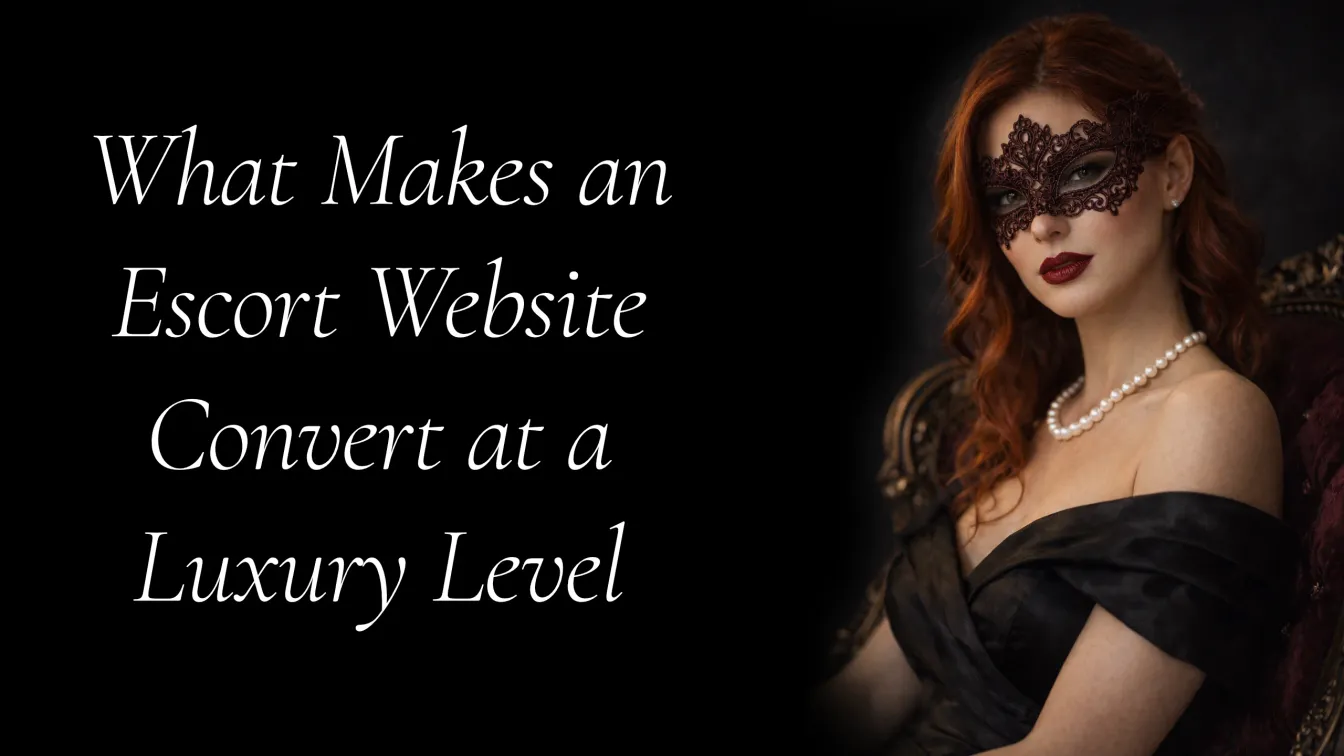
Luxury clients make rapid judgements about websites — typically within three seconds — based on perceived calibre rather than explicit details like rates or galleries. The core challenge is not visibility but conversion quality: attracting and converting high-value clients who have options.
The Luxury Gap
Most escort websites fail conversion despite professional appearance because they lack understanding of luxury psychology. The visual authority of your site must communicate three things simultaneously: exclusivity, discretion, and competence. When any one of these is absent or contradicted, the sophisticated client you are trying to attract disengages without explanation.
The Five Conversion Layers
Layer 1: Visual Authority
Restraint, not maximalism. The luxury signal is whitespace, typographic consistency, and image quality — not abundance. Bespoke design signals serious brand positioning. 72% of luxury consumers prefer personalised digital interactions. Your site should feel as though it was built specifically for the client looking at it.
Layer 2: Copy That Commands Status
Luxury copy does not over-explain. Over-explanation signals insecurity. Instead, it targets client identity and aspirations — not just desires. It creates status congruence with sophisticated clientele. It declares rather than justifies.
The distinction is between writing that lists what you offer and writing that articulates who you are for. The former is a menu. The latter is an invitation.
Layer 3: Trust Architecture
Specific, contextual proof elements placed strategically throughout the site. Micro-details — references to discretion, adaptability, cultural knowledge — accumulate into a felt sense of trustworthiness. Technical signals matter too: SSL, load speed, a professional domain. Avoid intrusive pop-ups, which signal that the site is optimised for the operator’s needs rather than the client’s experience.
Layer 4: The Enquiry Pathway
The contact experience must feel easy, discreet, worthwhile, and promising. Minimal forms. Calm direction. Language that acknowledges the client’s discernment rather than assuming urgency. UX refinements to the enquiry pathway have documented conversion improvements of 76% — a significant number for what appears to be a small change.
Layer 5: SEO as Client Filter
SEO optimised for intent-rich, luxury-specific language pre-qualifies traffic before it arrives. A visitor who found you by searching “elite companion for private dinner in Geneva” is categorically different from one who found you through a broad directory browse. The former has already filtered himself in. He has told you exactly what he is looking for.
Critical Signals Often Overlooked
Response protocol language — How you describe your response time and communication preferences communicates scarcity and professionalism simultaneously.
Gallery curation — Quality over quantity, always. Ten exceptional images outperform forty average ones.
Pricing presentation — Clear, confident, without apology. Clients who need to negotiate are not the clients you are building for.
Mobile experience parity — 70 to 80% of luxury decisions are influenced by mobile. Your mobile site is not a simplified version — it is the primary version.
The Cost of Getting This Wrong
Unaddressed conversion failures are silent. Prospects who visit and conclude inadequacy leave without making contact and without telling you why. The cost is not visible in your analytics — it is visible in your bookings. The distinction this framework addresses is between a practice built around volume and one built around premium clients who book consistently and return.
Frequently Asked Questions
How quickly do luxury clients make decisions? Initial impressions form within three seconds. The full evaluation — photography review, biography reading, rates assessment — typically happens across one to three visits over several days before first contact.
Can SEO actually improve the quality of enquiries? Yes, significantly. Targeting intent-rich, experience-specific keywords attracts visitors who have already self-qualified. They arrive knowing what they want. The conversion rate from this traffic is dramatically higher than from broad terms.
My site looks premium — why am I still not converting? Visual premium and conversion premium are different things. A site can look correct and still fail at the copy layer, the enquiry pathway layer, or the trust architecture layer. Usually, addressing all layers simultaneously produces results; addressing one in isolation rarely does.
Where should I start? Run an honest audit of Layer 4 first — the enquiry pathway. It is the most commonly underinvested layer and the one where interested visitors most frequently abandon. Then work backwards through the other layers.